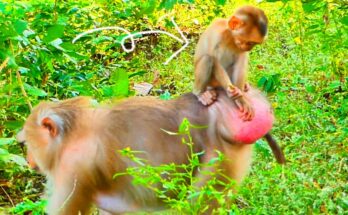
In the quiet stillness of the early morning forest, before the sun had fully lifted its golden face above the treetops, a fragile life trembled on the forest floor. A newborn monkey—no bigger than two tiny hands cupped together—lay barely moving, its soft cries almost swallowed by the whispering wind. The umbilical cord still attached, the fur still wet, and the heartbeat faint, it was clear the little one had entered the world only a few hours before. And yet, for reasons nature sometimes keeps secret, it had been abandoned.
But fate often writes stories with unexpected tenderness.
A group of wildlife rescuers, who had been patrolling after reports of poachers in the area, heard a sound so thin and delicate that they almost mistook it for a chirping insect. When they followed the sound, what they found touched them deeply: a newborn monkey, eyes still sealed shut, chest rising shallowly, fighting for a life it had barely begun to live.
Their hearts tightened, and without hesitation, they moved into action.
They gently wrapped the infant in a soft cloth, warming its chilled body with their own hands. Every movement was careful, tender, and full of silent hope—because in moments like these, hope is often the first medicine. The rescuers knew that such a tiny creature could not survive long without a mother’s warmth, milk, and protection. Time was not just important; it was everything.
At the rescue center, the team worked tirelessly. They cleaned the newborn, checked for injuries, and provided the first drops of special formula meant to mimic a mother’s milk. The baby monkey, though weak, responded—its tiny fingers curling around the rescuer’s thumb, as if begging for another chance. That one small grip felt like a promise that it was not ready to give up.
Over the next hours, the team discussed the possibility of reuniting the infant with its troop. Monkeys, especially many primate species, have strong social bonds, and sometimes, if circumstances allow, a troop or even a new mother can accept an abandoned infant. It was a delicate decision, balancing survival and the natural order.
At dawn the next day, the rescuers returned to the forest with the newborn safely swaddled. They located the troop the baby likely belonged to, observing quietly from a distance. The dominant female watched them intently, sensing something unusual. When the rescuers gently placed the infant at the edge of her territory and stepped back, the forest held its breath.
Slowly, with cautious movements, the female approached. She sniffed, hesitated—and then, in a moment that brought tears to more than one rescuer’s eyes—she lifted the baby into her arms. The newborn, recognizing warmth and heartbeat, nestled instinctively against her chest.