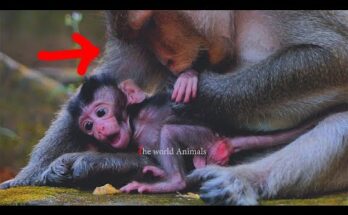
In the quiet stillness of the early morning forest, a heartbreaking scene unfolded high among the branches. A newborn monkey, fragile and trembling, clung desperately to a thin limb after slipping from his mother’s grasp. His tiny cries echoed through the canopy, each sound filled with confusion, fear, and longing. He had entered the world only moments earlier, yet the warmth and comfort he instinctively searched for were nowhere to be found.
The mother sat several branches away, her body tense and her eyes distant. For reasons not always understood by the human heart, some primate mothers reject a newborn—sometimes due to stress, weakness in the infant, or an instinctive sense that the baby might not survive. But whatever the cause, the result was always the same: a tiny life left to struggle alone. The forest around them seemed to hold its breath as the newborn attempted to pull himself up, his tiny fingers slipping again and again against rough bark.
With a soft whimper, he fell a second time—this time into a gathering of leaves below. The fall was not long, but for such a delicate creature it was enough to leave him shaken and helpless. Yet even then, he tried to stand, swaying like a newly sprouted plant fighting to rise toward the sun. His determination was both inspiring and unbearably sad, a silent plea for a love he had not yet received.
Other monkeys in the troop watched from a distance. Some chattered nervously, others glanced between the fallen infant and his mother, as if trying to understand the silent tension between them. A few young females approached hesitantly, driven by curiosity and instinct, but the mother’s warning calls kept them back. She was torn between confusion and fear, unable to accept the newborn as her own, yet unwilling to let others near him.
Minutes felt like hours as the baby continued his small, trembling attempts to crawl back toward the branches above. The forest floor seemed enormous around him, and every rustle of leaves or distant call of another animal made him flinch. It was a world far too big for such a tiny life.
Still, he did not give up.
With each shaky breath, he pushed forward—dragging himself across the ground, reaching toward a root that might help him climb. His instinct to survive was powerful, even as his strength began to fade. The cries he released were softer now, more fragile, as though each sound carried the last pieces of hope in his tiny body.
Above him, the mother paced restlessly. Her instincts conflicted in ways only nature could explain. She listened, she watched, yet she remained still, unable to cross the distance between them.
And so the little newborn continued his lonely struggle, a tiny heartbeat fighting against the coldness of rejection. It was a moment both tragic and deeply human—a reminder that even in the animal world, love is not always guaranteed, and survival can be the bravest act of all.Attach